30th July 2026
Sigiriya Ravana Palace: History vs Legend
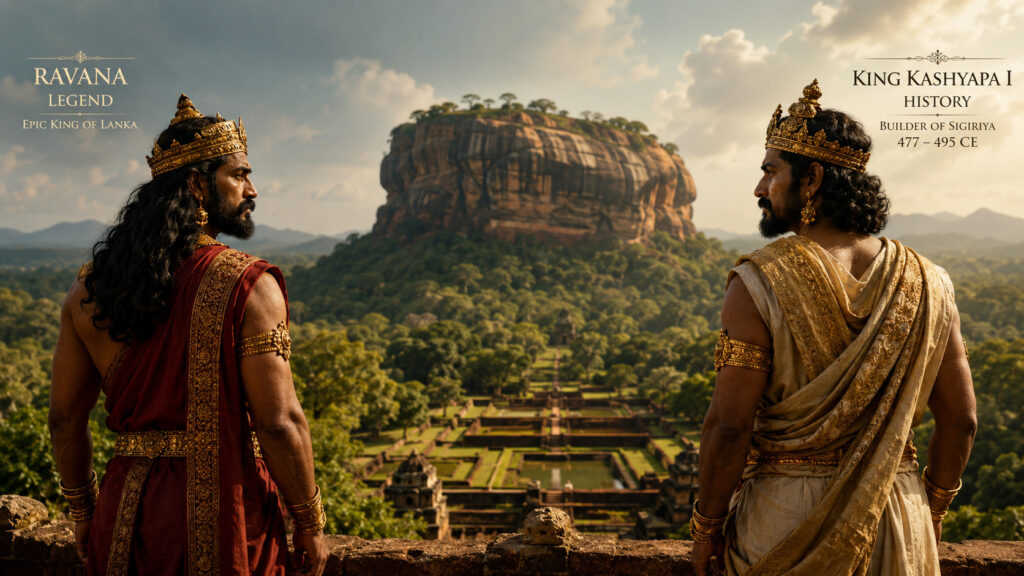
You spot it from kilometres away. A colossal column of orange-brown granite punching straight up out of the flat Sri Lankan jungle, so sheer and sudden it looks almost placed there by a restless god. And the moment you start reading about this place, you walk headfirst into one of the most spirited heritage debates in South Asia. Was Sigiriya built by Ravana as his legendary golden citadel, or is the Sigiriya Ravana Palace story a modern myth layered over the very real, very human ambition of a fifth-century king?
The archaeology department has a clear answer: King Kashyapa built this rock fortress between 477 and 495 CE. The legend, though, has a pulse of its own. It has been galloping through tour buses, Instagram reels, and Ramayana Trail itineraries for decades now, and it shows zero signs of slowing down. Both stories deserve a proper hearing. So grab a cup of plain tea, settle in, and let us walk the whole thing from the moat to the summit.
Sigiriya at a Glance: What You Are Actually Looking At
Before anyone picks a side, a quick orientation.
Sigiriya (pronounced roughly si-GIR-ee-ya; the older Sinhala form is Sinhagiri, meaning “Lion Rock”) is a near-vertical granite monolith rising about 200 metres above the surrounding plains of Matale District, roughly 170 km north-east of Colombo. The rock itself is the hardened magma core of a long-eroded volcano, exposed over millions of years. Nothing human about the geology. Everything on and around it, though, is startlingly, gloriously human.
In 477 CE, King Kashyapa I chose this improbable perch as the site for a brand-new capital. Over the next eighteen years his engineers carved staircases into the living rock, painted a gallery of luminous frescoes halfway up the western face, polished a mirror-smooth wall beside them, laid out symmetrical water gardens and boulder gardens at the base, and crowned the flat summit (roughly 1.6 hectares of usable space) with a full royal palace complex. A gigantic brick-and-plaster lion, paws still straddling the final staircase, guarded the last approach to the top. Hence the name: Lion Rock.
Kashyapa’s reign ended violently in 495 CE. After that, Sigiriya drifted into centuries of monastic use, then jungle reclamation, then rediscovery by British-era surveyors in the 1820s and 1890s. UNESCO inscribed it as a World Heritage Site in 1982, calling it one of the finest examples of ancient urban planning in South Asia. Around 700,000 visitors climb it every year now. The queue at the lion’s paws on a December morning can rival a concert entrance.
That is the short version. The long version is where the Sigiriya Ravana Palace question gets properly interesting.
The Chronicle Record
Kashyapa’s Ambitious, Guilt-Ridden Masterpiece
Sri Lanka’s written history runs deep. The Mahāvaṃsa and its continuation, the Cūḷavaṃsa, are Pali-language chronicles compiled by Buddhist monks over many centuries. They cover dynasties, wars, irrigation projects, and monastic politics in considerable detail. And when it comes to Sigiriya, they are unambiguous.
The Cūḷavaṃsa tells us that Prince Kashyapa (son of King Dhatusena) seized the throne in 477 CE after imprisoning his father and driving his half-brother Moggallāna into exile in southern India. Kashyapa knew Moggallāna would return with an army. Anuradhapura, the traditional capital, sat on open plains. Hard to defend. So Kashyapa looked at that 200-metre rock and saw a solution.
He moved the capital to Sigiriya. The chronicle records that he “built his palace on top of the rock and decorated its sides with colourful frescoes.” He surrounded the base with a double moat system, ramparts, and the elaborate pleasure gardens that still stun visitors today. The summit palace included audience halls, bathing pools, and living quarters whose foundation stones you can still trace.
Here is a detail I find genuinely moving. The Cūḷavaṃsa says Kashyapa wanted his summit residence to resemble Alakā, the mythical mountain-city of Kubera, the god of wealth. He was building a heaven on earth to outrun a very earthly fear: his brother’s inevitable return.
And return Moggallāna did, in 495 CE. Kashyapa rode out to meet him on the plains. His elephant balked at a swamp, his troops read the retreat as a rout, and Kashyapa fell on his own sword. Moggallāna handed Sigiriya back to the Buddhist monastic community. The rock served as a monastery for several centuries after that, until roughly the 13th or 14th century, before the jungle swallowed it whole.
One small but important note: the Mahāvaṃsa proper ends well before Kashyapa’s time. It does not mention Sigiriya at all. The Cūḷavaṃsa handles the story, and it does so in a handful of verses. The chronicle’s monk-author was no fan of Kashyapa (a usurper and a patricide, in the monastic moral ledger), so the passage is terse. It names the rock, credits the construction, and moves on. No fanfare. No Ravana. Not a syllable about any pre-Kashyapa palace or flying chariot.
Archaeological work backs the chronicle to the letter. H.C.P. Bell conducted the first systematic survey in the 1890s. Professor Senarat Paranavitana led major excavations and conservation in the 1930s and 1940s, and his reading of the site remains foundational. Later UNESCO-led projects in the 1980s and 1990s mapped the gardens, stabilised the frescoes, and confirmed the construction dates. Every structural layer on the rock, from the lion gateway to the summit cisterns, aligns with a late-fifth-century build. Brahmi cave inscriptions at the base show Buddhist monks using the lower caves a few centuries before Kashyapa, which fits neatly: the rock was a known monastic site that a king then commandeered and transformed.
No excavation, no peer-reviewed paper, no stratigraphic layer at Sigiriya has produced evidence of a pre-Kashyapa royal occupation, a Hindu shrine, or anything resembling a Ravana-era structure. The archaeology is consistent, and it points one way. The Sigiriya Ravana Palace theory, however popular on social media, has never produced a single artefact, inscription, or structural date to support it.
Was Sigiriya Built by Ravana?
What the Ramayana Actually Says
Now, the other story. The one that lights up YouTube thumbnails and fills the commentary on Ramayana Trail bus tours. The question that keeps surfacing in travel forums and AI search engines alike: was Sigiriya built by Ravana?
In Vālmīki’s Rāmāyaṇa, composed roughly between the 5th century BCE and the 1st century BCE in its surviving form, the demon-king Rāvaṇa rules the island kingdom of Laṅkā from a magnificent golden city perched on the Trikūṭa mountains. His palace is described in staggering terms: walls of gold, gates studded with gems, corridors guarded by four-tusked elephants. He abducts Sītā, wife of Prince Rāma, and holds her in the Aśoka grove of Laṅkā until Rāma crosses the ocean, lays siege, and kills him.
It is a magnificent epic. It has shaped art, theatre, devotion, and identity across South and South-East Asia for over two millennia. Sri Lanka’s Tamil community, in particular, holds deep cultural connections to the Rāmāyaṇa’s Lanka episodes, and several sites around the island (Sītā Amman Temple near Nuwara Eliya, the cave complexes at Ravana Falls, the shrine at Koneswaram) feature in living devotional traditions.
Here is the critical gap, though. The Rāmāyaṇa never names Sigiriya. Not once. The epic’s Lanka is described as a vast island-city hundreds of yojanas from the Indian mainland, a scale that fits no single rock in the real world. Later commentaries and folk retellings gradually equated the epic’s Laṅkā with the island of Sri Lanka, which is understandable and culturally rich. That equation is a broad, symbolic mapping. It does not drop a pin on Sigiriya. It does not say, “Rāvaṇa’s vimāna landed on this particular granite outcrop in Matale District.”
So where does the Sigiriya Ravana Palace link actually come from? Mostly from the last few decades of tourism storytelling and social-media amplification. A 2018 Times of India travel piece floated the idea that Sigiriya was where Rāvaṇa “had his palace,” complete with references to 1,000 stairs and a kind of ancient lift. Tour operators packaging the Ramayana Trail for Indian visitors sometimes fold Sigiriya into the itinerary with a wink and a legend. Vlogs label a flat rock terrace near the summit as “Rāvaṇa’s helipad,” the supposed landing pad for his legendary flying chariot, the Puṣpaka Vimāna.
These stories are fun to tell around a campfire. They make for a great reel. They carry zero archaeological or textual ballast. In early 2025, an Indian archaeologist writing for a travel column put it plainly: visitors should set aside the version of Sigiriya’s history “pushed by social media influencers” and look at the fifth-century evidence instead. The physical remains are Kashyapa’s. Full stop.
None of this is a dismissal of Rāvaṇa as a cultural figure. He is enormous in Sri Lankan folklore, in Tamil literary traditions, in Sinhala popular imagination, and across the broader Hindu-Buddhist storytelling world. Some modern Sinhala nationalist writers and Tamil scholars have reinterpreted him as a great ancient Lankan king rather than a villain, and that reinterpretation carries real emotional weight for many people. The Rāma-Rāvaṇa narrative is part of the island’s living cultural fabric. What the evidence does not support is the specific claim that Sigiriya’s stones were laid by Rāvaṇa’s architects or that its summit hosted a golden palace predating Kashyapa by millennia.
The two stories can coexist in a traveller’s mind. The rock is real. The chronicle king is real. And the epic that has enchanted a civilisation for twenty-five centuries is real in the way that all great stories are real. You just do not need to confuse one for the other to enjoy either.
The Frescoes: Cloud Maidens and Royal Propaganda
Halfway up the western face, sheltered by a slight overhang in the rock, a gallery of painted figures has stared out at the jungle for fifteen centuries. Twenty-one women survive today. Scholars believe the original series stretched much further along the cliff, possibly numbering in the hundreds, before weather and neglect took their toll.
The paintings are gorgeous. Rich ochres, greens, and pale golds dominate the palette. Each woman emerges from a swirl of cloud-like scrollwork, bare-waisted, adorned with heavy jewellery, holding lotus blossoms or making gestures of offering. Their skin tones shift between a warm golden hue and a deeper blue-green. The artists used this contrast deliberately to create visual depth. The brushwork remains confident, fluid, and remarkably well-preserved.
Tour folklore sometimes labels these women as “Rāvaṇa’s wives” or as portraits of captive queens from the epic. It is a vivid image, and it sells well on guided tours discussing the Sigiriya Ravana Palace legend. Art historians read the paintings entirely differently.
The dominant scholarly interpretation, held consistently since Ananda Coomaraswamy’s early twentieth-century analyses and reinforced by Paranavitana’s mid-century work, identifies these figures as apsarās. These are celestial nymphs of Indic cosmology. They act as sky-maidens and cloud spirits. The scrollwork surrounding them represents literal storm clouds. The women are emerging from the heavens, looking down on the mortal king’s domain below.
This reading fits perfectly within Kashyapa’s stated ambition to make his summit residence resemble Alakā, the mythical city of Kubera. In Hindu and Buddhist cosmology, Alakā is populated by apsarās and gandharvas, celestial musicians and dancers. Painting them on the rock face was an act of royal theology. Kashyapa declared through pigment and plaster that his fortress existed at the boundary between the human and the divine.
The technique and style align squarely with fifth-century South Asian painting traditions. Parallels exist at Ajanta in Maharashtra and in the broader corpus of Gupta-era art. The pigments, the underdrawing method, and the compositional grammar all belong to that mid-first-millennium CE world. Nothing in the material analysis suggests a composition date thousands of years earlier.
The earliest written responses to these paintings settle the debate. Visitors between the eighth and tenth centuries scratched their reactions into the Mirror Wall. They describe the figures as divine ladies, cloud maidens, and celestial beauties. A single inscription calling them Rāvaṇa’s consorts remains undiscovered. The people who actually stood in front of these paintings, within a few centuries of their creation, saw apsarās. The epic reading is a modern graft, centuries removed from the art itself.
The Mirror Wall: 1,500 Verses That Settle the Argument
Just below the fresco gallery, the ascent path is bordered by a wall of brick and lime plaster. The builders polished it to such a sheen that it once reflected the viewer’s face. Hence the name: Mirror Wall Sigiriya. Over the centuries after Kashyapa’s death, when the site transitioned into a monastic and then a pilgrimage destination, visitors began scratching verses into that polished surface. Around 1,500 such inscriptions survive. Paranavitana transcribed and published 685 of them in his landmark 1956 volume, Sigiri Graffiti.
These poems are extraordinary. They are personal, immediate, sometimes funny, sometimes lusty, and sometimes tender. Written in medieval Sinhala, Tamil, and Sanskrit, they record the reactions of ordinary travellers, monks, soldiers, and courtiers who climbed the rock between roughly the seventh and thirteenth centuries. They gush about the Sigiriya frescoes. They marvel at the engineering. They complain about the heat. A few bicker about who got the best viewing spot.
One verse reads, in translation: “Who is not happy when he sees those rosy palms, those rounded shoulders, those gentle eyes?” Another calls the painted women “lightning maidens.” A third thanks the king who built this wonder. The tone throughout is secular admiration, aesthetic delight, and occasional spiritual reflection. The rock is treated as the work of a legendary human king.
Not one of the 1,500 verses mentions Rāvaṇa. Not one invokes the epic. Not one calls the site a vimāna landing site or a golden demon-king’s citadel. The word “Laṅkā” appears in a few verses, always in the broad poetic sense of the island itself, never tied to an epic narrative at this specific rock.
Think about what that means. Hundreds of literate visitors over six centuries, leaving spontaneous reactions in three languages, and the epic story never once crosses their minds. The legend that now saturates Instagram captions and tour-bus microphones simply did not exist in connection with this site for most of its recorded history.
The Mirror Wall also carries a small plaque from a later era calling the site devālu purī, “the city of the gods.” That phrase reflects Kashyapa’s own royal self-mythology and his Alakā aspiration. It is fifth-century propaganda, not epic theology.
If you ever want the strongest single piece of evidence separating the history from the myth, stand in front of that wall. Read a few translated verses. Listen to what the actual medieval visitors said. They tell you plainly.
(Planning the climb itself? Tickets, timing, the best route from Kandy or Colombo, what to wear, and how to dodge the midday heat are all broken down in our dedicated [Sigiriya visitor guide – link here]. This article stays focused on the history and the legend, but that companion piece will sort out the logistics so you can just show up and stare upward.)
The Gardens and Engineering: Kashyapa’s Real Flex
The Sigiriya Ravana Palace legend paints the rock as a war-fortress, a demon-king’s impregnable stronghold. Look at the actual layout, though, and something else emerges. The base is a pleasure garden first and a defensive stronghold second. It is a hydraulic wonderland designed as much for delight as for protection.
The water gardens at the base are among the oldest surviving landscaped gardens in the world. They are laid out in precise symmetrical blocks on either side of the main east-west axis leading to the rock. Channels, pools, and fountains were fed by an elaborate system of underground conduits and surface drains. Many of these original drains still function perfectly during the rainy season. The boulder gardens to the north and south incorporate natural rock formations into the design, with cisterns cut into the stone and covered walkways threading between the outcrops.
The engineering required to pump water to the summit cisterns, to maintain pressure in the fountains, to drain the moats, and to stabilise the brick-and-plaster structures on a sheer granite face represents a sophisticated understanding of hydrology and structural mechanics. UNESCO World Heritage Sri Lanka citations highlight the site’s significance in the history of urban planning and landscape architecture specifically because of this hydraulic mastery. A war-fortress does not need symmetric fountains. A pleasure capital does.
Kashyapa built a city. The moats, the ramparts, the lion gateway, the terraced gardens, the fresco gallery, the mirror wall, and the summit palace are components of an integrated royal capital. The coherence of the plan, the consistency of the construction materials, and the stratigraphic dating of every layer converge on one builder and one eighteen-year building programme in the late fifth century.
That reality is, in its own right, astonishing. You do not need to borrow a flying chariot to make the site impressive. The human ambition here is impressive enough. A guilty, frightened king looked at a column of rock and decided to build heaven on top of it. He succeeded. And then he lost everything on a swampy battlefield eighteen years later. That story has more texture, more tragedy, and more grit than any golden-palace legend can offer.
Why the Sigiriya Ravana Palace Story Keeps Growing
If the evidence is so clear, why does the Rāvaṇa version keep spreading? A few overlapping reasons drive this, none of them malicious, most of them deeply human.
The Ramayana Trail economy: Sri Lanka’s tourism board and private operators have, at various points, packaged a Ramayana Trail targeting Indian travellers. The itinerary links sites like Sītā Amman Temple, Ravana Falls, and the Koneswaram shrine. The rock sometimes gets folded in by proximity or by loose association. Once a site lands on the brochure, the legend accretes. Guides embellish. Tourists photograph. The story compounds.
Social media amplification: A dramatic claim about a 5,000-year-old helipad makes a better reel than a nuanced explanation of a fifth-century cistern. Algorithms reward spectacle. The Rāvaṇa framing gets clicks, shares, and saves. The Kashyapa framing gets a polite nod and a scroll past. Over millions of impressions, the legend outshouts the archaeology.
Cultural reclamation: For some Sinhala nationalists and some Tamil literary scholars, Rāvaṇa has been reinterpreted as a noble, learned, ancient Lankan sovereign rather than a one-dimensional villain. This reading has genuine emotional and cultural resonance. It feeds a desire to root the island’s identity in a grander, more ancient past than the fifth century. The rock, being the most visually dramatic heritage site in the country, becomes a natural candidate for that projection. The impulse is entirely understandable. The archaeology, though, does not bend to accommodate it.
The sheer romance of the idea: A flying chariot. A golden city. A ten-headed king who composed music and mastered the Vedas. These are intoxicating images. They make the rock feel older, stranger, and more mythic. For a visitor standing at the base, craning their neck upward, the romantic version is right there in the imagination whether the evidence supports it or not. That is perfectly fine. You can enjoy the shiver of the legend while knowing, intellectually, whose hands actually laid the bricks.
The key is labelling. History and myth can share the same landscape. They do it all over the world. The trick is avoiding presenting one as the other. The real story is rich enough. Kashyapa’s paranoia, his artistic ambition, his engineering genius, and his lonely end make up a narrative with blood and beauty in equal measure. It requires no golden overlay to hold a traveller’s attention.
FAQs: Sigiriya, Rāvaṇa, and Kashyapa
Was Sigiriya built by Ravana or King Kashyapa?
Every surviving text and every archaeological layer points to King Kashyapa I, who ruled from 477 to 495 CE. The Cūḷavaṃsa names him as the founder. UNESCO’s World Heritage citation names him. The ruins match his era in materials, style, and engineering. No credible historical source attributes the construction to anyone earlier.
Does the Ramayana mention the Sigiriya Ravana Palace?
No. The epic describes Rāvaṇa’s Laṅkā in grand, mythic terms but never identifies it with any specific rock or site in present-day Sri Lanka. The equation of epic Laṅkā with the island is a later cultural interpretation, and even that broad equation does not single out this specific rock.
No. The epic describes Rāvaṇa’s Laṅkā in grand, mythic terms but never identifies it with any specific rock or site in present-day Sri Lanka. The equation of epic Laṅkā with the island is a later cultural interpretation, and even that broad equation does not single out this specific rock.
What do the Sigiriya frescoes actually depict?
The prevailing scholarly view is that they represent apsarās, celestial nymphs from Indic cosmology, rendered in a fifth-century painting style consistent with Ajanta and other Gupta-era traditions. They are portraits of divine beings, not portraits of Rāvaṇa’s wives or of any epic character. The cloud-scroll motifs and the colour palette support this reading.
The prevailing scholarly view is that they represent apsarās, celestial nymphs from Indic cosmology, rendered in a fifth-century painting style consistent with Ajanta and other Gupta-era traditions. They are portraits of divine beings, not portraits of Rāvaṇa’s wives or of any epic character. The cloud-scroll motifs and the colour palette support this reading.
Do the Mirror Wall inscriptions mention Rāvaṇa?
Not once. Across roughly 1,500 verses spanning the seventh to the thirteenth centuries, in Sinhala, Tamil, and Sanskrit, there is no reference to Rāvaṇa, Rāma, Sītā, or any epic episode. The verses praise the frescoes, admire the engineering, and record personal reactions to the site.
Not once. Across roughly 1,500 verses spanning the seventh to the thirteenth centuries, in Sinhala, Tamil, and Sanskrit, there is no reference to Rāvaṇa, Rāma, Sītā, or any epic episode. The verses praise the frescoes, admire the engineering, and record personal reactions to the site.
Is the “Ravana vimana” helipad real?
The flat rock terrace near the summit is a colloquial, tourism-driven nickname. There is no archaeological evidence that it served any function related to a flying machine or any pre-Kashyapa structure. It is a natural geological feature incorporated into the fifth-century palace complex.
The flat rock terrace near the summit is a colloquial, tourism-driven nickname. There is no archaeological evidence that it served any function related to a flying machine or any pre-Kashyapa structure. It is a natural geological feature incorporated into the fifth-century palace complex.
Why do some tour guides still tell the epic story?
Commercial incentive and cultural enthusiasm drive this. The Ramayana Trail attracts a large segment of regional tourism, and the epic angle adds dramatic flair. Some guides genuinely enjoy the legend and share it as folklore. The issue arises only when it is presented as historical fact rather than as a modern narrative overlay.
Commercial incentive and cultural enthusiasm drive this. The Ramayana Trail attracts a large segment of regional tourism, and the epic angle adds dramatic flair. Some guides genuinely enjoy the legend and share it as folklore. The issue arises only when it is presented as historical fact rather than as a modern narrative overlay.
Is the site a UNESCO World Heritage Site?
Yes. It was inscribed in 1982 under criteria ii, iii, and iv, recognising its outstanding value in urban planning, landscape architecture, and as an exceptional example of a royal citadel. The official UNESCO description credits King Kashyapa I.
Yes. It was inscribed in 1982 under criteria ii, iii, and iv, recognising its outstanding value in urban planning, landscape architecture, and as an exceptional example of a royal citadel. The official UNESCO description credits King Kashyapa I.
Can I enjoy the legend and still respect the history?
Absolutely. The epic is one of humanity’s great stories, and Sri Lanka’s cultural ties to it run deep, especially in Tamil traditions. Enjoying the epic, visiting linked temples, and feeling the mythic frisson of the landscape are all valid and enriching experiences. The only caution is to avoid letting the legend overwrite the archaeology in your understanding of what the physical site actually is and who built it.
Absolutely. The epic is one of humanity’s great stories, and Sri Lanka’s cultural ties to it run deep, especially in Tamil traditions. Enjoying the epic, visiting linked temples, and feeling the mythic frisson of the landscape are all valid and enriching experiences. The only caution is to avoid letting the legend overwrite the archaeology in your understanding of what the physical site actually is and who built it.