23rd May 2026
Sigiriya Drone, Balloon and Photo Rules You Will Get Wrong
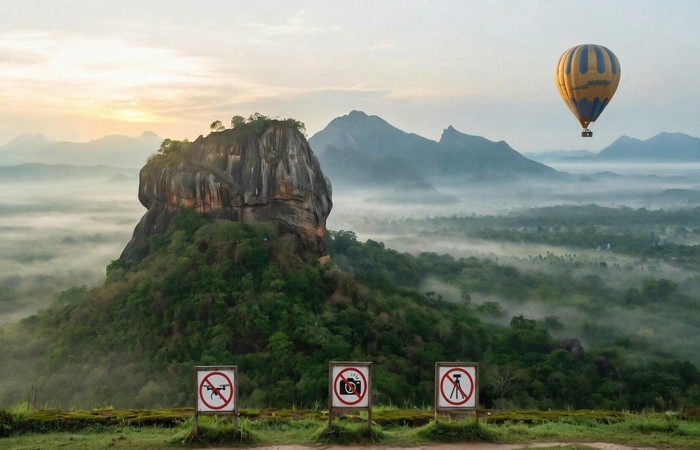
You show up at Sigiriya picturing a perfect drone top down, a balloon drifting right over the Lion Rock, and a close up of those cloud maidens for your feed. Then a guard waves you off, your drone stays zipped up, and your balloon pilot cheerfully says he is legally not allowed to fly where you want. It happens constantly.
Sigiriya’s drone and photography rules are something crucial you should know before planning your shoot. It is a UNESCO World Heritage archaeological reserve with an airfield nearby and very territorial hornets. That combo makes it one of the strictest places to fly or shoot in Sri Lanka. Here is how you stay out of trouble and still get the shot.
Drone rules in Sigiriya
First, the national rule. The Civil Aviation Authority of Sri Lanka says once you have brought your drone you shall obtain a temporary registration via online prior to any operation and you must comply with IS53. If you intend to operate over heritage sites you will need clearance from local authorities in addition to CAASL clearance.
Registration means applying through the CAASL online portal, declaring make, model, serial number, weight and purpose, and paying a fee often listed around 50 dollars. You must stay below 120 meters, avoid airports and fly only in designated zones. Commercial operators now face an even more formal licensing system that CAASL has been rolling out for 2026.
Now Sigiriya itself. The most cited independent guide puts it bluntly: Sigiriya Rock Fortress falls under strict no fly zone regulations and permission for recreational flights is exceptionally difficult, if not impossible. Even with a CAASL registration, you would still need separate approval from the Department of Archaeology, which is rarely granted to tourists.
Try anyway and you risk confiscation. As one Sigiriya guide notes, confiscation occurs when visitors violate drone rules. Leave the drone at your hotel in Habarana or Dambulla. For that aerial look, climb Pidurangala instead. It gives you the classic wide view of Sigiriya without the paperwork.
Hot Air Balloon Rules in Sigiriya
Sunrise ballooning is magic here, just not for the reason you think. Operators list altitude as flying 500 to 2000 feet with a bird’s eye view around Sigiriya, most averaging around 1000 feet for panoramic views.
Every reputable crew will tell you before takeoff: just be aware that this, nor any other hot air balloon ride, will not take you over the Sigiriya site. Listings spell it out clearly: for security reasons, we cannot directly fly over the archaeological site and flying near Sigiriya Lion Rock is restricted because it is an archaeological site. Traveler forums add that balloons stay 2 to 3 km from the rock due to airport zone.
What do you actually get? A slow drift over paddy, lakes and jungle as the sun comes up behind Sigiriya. You see the rock from a distance, which photographs beautifully in that soft light. And yes, you can take photos and videos during the flight, pilots even rotate the basket so both sides get a clear shot.
Tips for you: book for your first morning, flights are weather dependent and sunrise only. Wear a warm layer, it is chilly at 5 AM. Do not book expecting a summit top down. If you want that image, the museum shop sells a licensed print that will beat anything shaky you would get while floating.
Photography On The Rock
Sigiriya’s drone and photography rules change every few meters, so watch the signs.
Photography is generally allowed in many open areas, especially in open areas, but flash is typically prohibited near the frescoes to protect ancient pigments. That is where your summit and water garden shots live.
The fresco gallery is different. As one climbing guide says, guards will say where flash is not allowed, follow that, and the Mirror Wall passage is narrow with people lined up behind you.
The Mirror Wall, or Ketapath Pawura, is a polished plaster wall that once reflected the king. Today it is a tight, one way flow. Tripods block everyone. The best advice from a full Sigiriya guide is simple: pay attention to photography signs, photography is actually banned in a few places along the hike, particularly along the frescoes wall.
How you get better photos anyway: keep flash off permanently inside the zone, switch to a fast prime instead of a tripod for low light stairs, use silent shutter, and save burst mode for the Lion Gate and the summit. For the famous damsels, rely on memory. The gallery is small, watched, and not worth the argument.
Your quick checklist before you climb
You have registered your drone via CAASL if you plan to fly anywhere in Sri Lanka, and you know heritage clearance is separate and rarely given for Sigiriya. You have left the drone at the hotel for Sigiriya day. You have booked the balloon knowing you will stay 2 to 3 km away for security and airspace reasons. You have set your camera to no flash, packed a light lens for the Mirror Wall queue, and brought a reusable bag because Sigiriya is now a polythene free zone.
Get this right and you will spend your morning enjoying the 1200 steps and the view, not negotiating with a guard about a rule you did not know existed. And yes, you will still come home with photos that make people ask how you got them.