02nd December 2025
Is Ritigala Sri Lanka's Best-Kept Secret?
Ritigala Sri Lanka sits just 45 minutes from Sigiriya, yet most guests at luxury hotels never hear about it. While everyone’s climbing the famous rock fortress, this ancient forest monastery remains practically deserted – which is exactly why you should go.
This isn’t another crowded tourist site with tour buses and souvenir stalls. Ritigala is a strict nature reserve covering 1,528 hectares where Buddhist monks built one of Sri Lanka’s most mysterious monasteries over 1,000 years ago. The monastery ruins cover 24 hectares scattered across the eastern slope. Locals call it “Dreadful Mountain,” though honestly, the only dreadful thing is how few people know about it.
Ritigala forest monastery stands 766 meters high – taller than Sigiriya, Dambulla, even Mihintale. The difference? Show up on a Tuesday morning and you’ll probably have the whole mountain to yourself.
Why Your Concierge Probably Won’t Mention It
Here’s the thing about staying at places like Sigiriya Jungles – you’re surrounded by world-famous attractions that everyone feels obligated to recommend. Sigiriya Rock, obviously. Dambulla Cave Temple. Polonnaruwa ancient city. All incredible, all worth visiting, all completely packed.
Ritigala in Sri Lanka offers something different: authentic exploration without the crowds. The monastery belongs to an enigmatic Buddhist sect called the Pamsukulikas (literally “rag robes”) who practiced extreme austerity. They built this complex specifically to get away from mainstream monastery life in Anuradhapura.
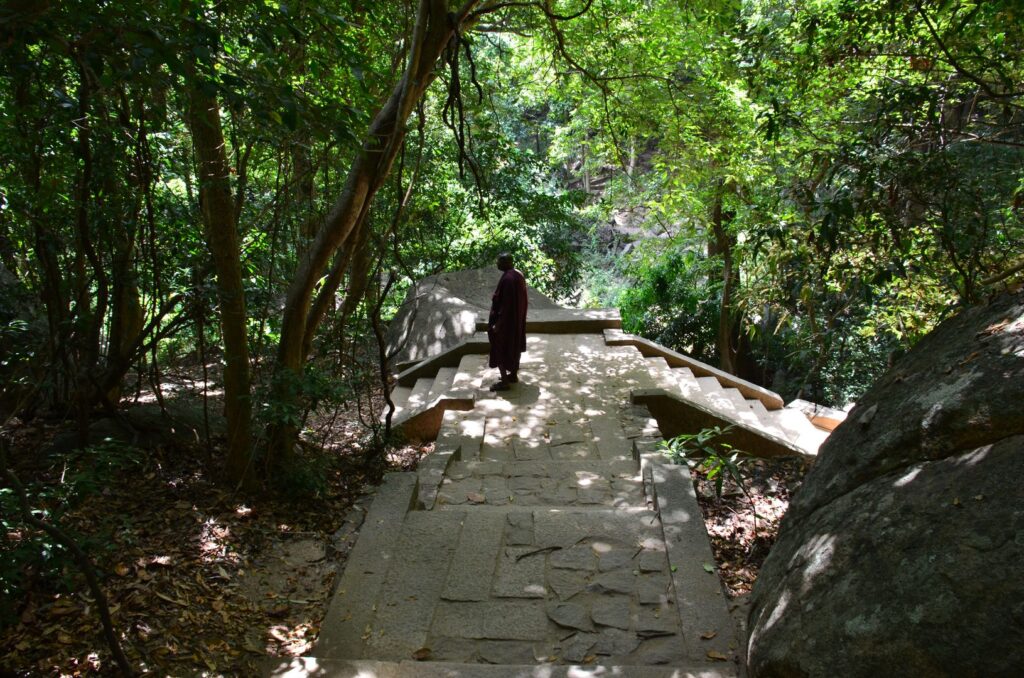
The site has zero traditional Buddhist icons. No stupas, no Bo trees, no Buddha statues. Just stone platforms, ancient staircases, bathing pools, and hospital ruins hidden in dense jungle. It feels more like discovering ruins than visiting a monument.
Most guests prefer the certainty of famous sites over the adventure of unknown ones. But that’s exactly what makes Ritigala special.
What Actually Happens During a Visit
The Approach
Your driver will take you off the main Anuradhapura-Habarana road, down increasingly rough tracks through farming villages. Rice dries on pavement, forcing vehicles into oncoming traffic lanes. Kids wave from doorways. This isn’t the polished approach you get at major sites.
The final stretch bounces through proper jungle track where elephants leave fresh dung in the road. No luxury coach buses make it here.
Banda Pokuna – The Ritual Bath
The monastery begins with an enormous man-made reservoir called Banda Pokuna. Built by King Pandukabhaya in the 4th century BC, this engineering marvel has a 366-meter circumference with a natural spring in one corner.
Monks bathed here before entering the sacred area. You can still see the precisely cut stone work and feel the cool spring water. This pool alone would be a major attraction anywhere else.
The Stone Bridge and Ancient Staircase
From the bathing pool, an intact stone-slab bridge leads to steps that disappear into thick jungle. These aren’t reconstructed tourist paths – they’re the original stones placed by medieval monks. Every step takes you deeper into genuine wilderness.
Hospital Complex with Ancient Medical Equipment
About halfway up, you’ll find ruins of what was clearly a sophisticated medical facility. Stone beds where patients lay. Oil-bath chambers. Grinding stones for preparing medicines. Even remarkably preserved stone urinals (the only decorated features in the entire complex).
This wasn’t primitive healthcare. These monks understood anatomy, surgery, and pharmaceutical preparation at levels that wouldn’t be out of place in modern practice.
Double Platform Structures
The trail leads to massive stone platforms – some of the largest structures in any Sri Lankan monastery. Monks gathered here for discussions and ceremonies. The engineering required to transport and position these enormous stone slabs on a mountain slope is genuinely impressive.
The Big Tree
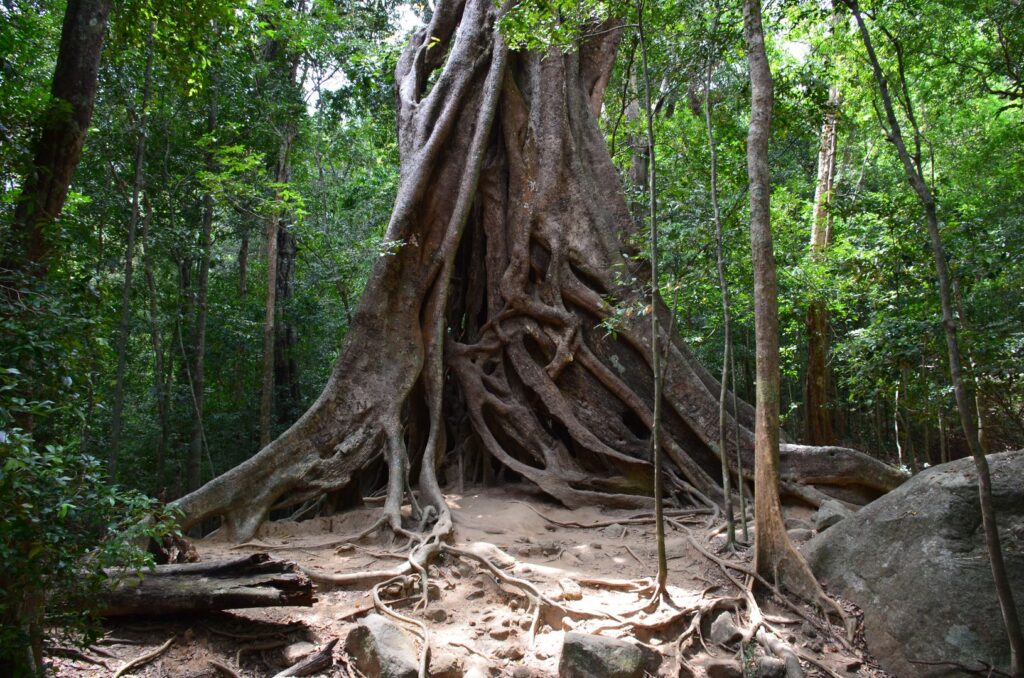
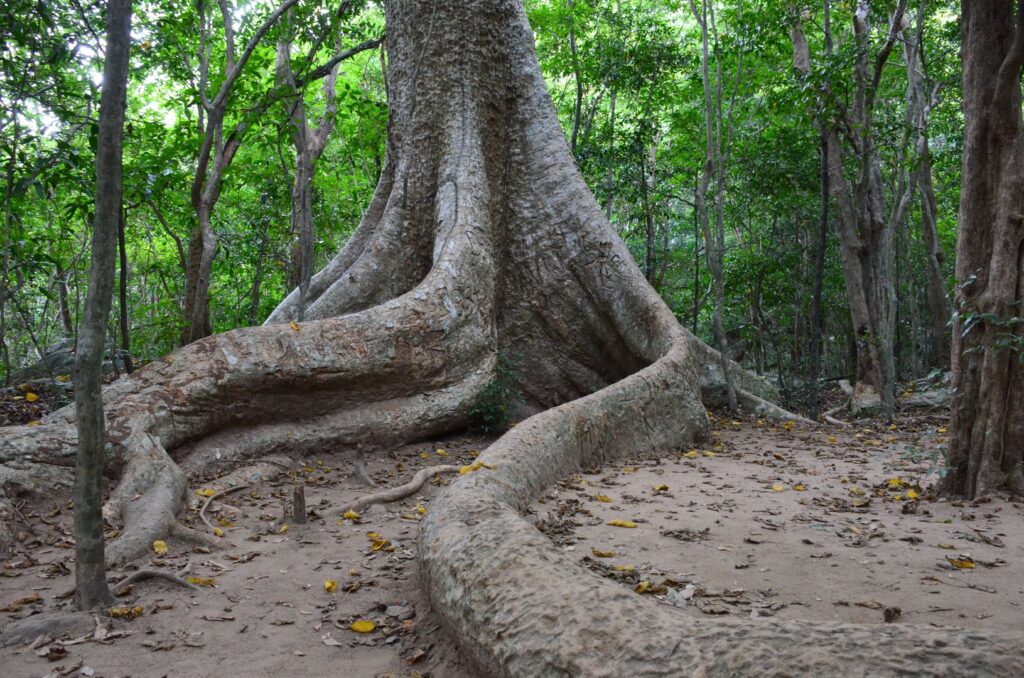
At the trail’s end stands what locals simply call “The Big Tree.” It’s exactly what it sounds like – an absolutely massive specimen with aerial roots creating a natural labyrinth. Ancient trees like this were considered sacred, providing shade and spiritual focus for meditation.
What Makes the Experience Unique
Genuine Discovery
Unlike restored sites where everything’s explained with plaques and guides, Ritigala forest monastery still feels mysterious. Archaeologists have theories about various structures, but much remains unknown. You’re genuinely exploring, not just viewing.
Wildlife Integration
This is a functioning nature reserve first, archaeological site second. Elephants use the same paths you’ll walk. Endemic bird species include Sri Lanka Gray Hornbill and Jungle Fowl. Sloth bears and leopards live here (though spotting them requires serious luck).
Microclimate
The mountain creates its own weather. Even during dry season, mist and clouds cover the summit, creating moisture when surrounding plains are parched. Plants and animals here exist nowhere else in the dry zone.
Archaeological Integrity
The site feels authentic because it largely is. Beyond basic path maintenance and some structural stabilization, the ruins remain as monks left them 1,000 years ago. No reconstruction, no modernization, no tourist facilities.
Practical Planning from Sigiriya Jungles
When to Go
Morning beats afternoon by miles. Cooler temps, birds actually moving around, better light for photos. Takes about 2-3 hours total, so you’re back at the hotel in time for a proper lunch and pool session.
8 AM start works well – lets you explore without melting in the heat or feeling rushed.
Pack Smart
- Decent hiking shoes that won’t slip on wet rocks
- Long pants and sleeves (jungle has thorns and bugs)
- Bug spray (trust us on this one, especially if it’s been raining)
- Water bottle and some snacks
- Camera plus spare batteries
- Small flashlight for poking around cave areas
Transportation
The 43-kilometer drive from Sigiriya takes about 45 minutes via decent roads until the final jungle approach. Sigiriya Jungles can arrange reliable transport with drivers familiar with the route.
Entrance fees are modest (around 3,600 LKR for foreign visitors) and archaeological guides are available at the site entrance.
Physical Requirements
The hiking is moderate – mostly gradual inclines on ancient stone steps. Total walking distance is about 3 kilometers round trip. Anyone reasonably fit can handle it comfortably.
Why This Matters for Luxury Travelers
Staying at properties like Sigiriya Jungles means you value authentic experiences over tourist crowds. Ritigala in Sri Lanka delivers exactly that – genuine exploration in a setting that feels untouched by mass tourism.
The contrast enhances your overall Sri Lankan experience. After visiting famous sites with their inevitable crowds and commercial activity, Ritigala offers contemplative solitude. You can actually hear birds, feel jungle atmosphere, and experience archaeological sites as they were meant to be experienced.
It’s also remarkably photogenic. The combination of ancient architecture, dense jungle, and dramatic mountain setting creates images you simply can’t capture at more developed sites.
For Nature Enthusiasts
The strict nature reserve status means pristine forest ecosystem with species you won’t see elsewhere. Endemic plants, rare birds, and the possibility of encountering larger wildlife add natural history dimensions to cultural exploration.
For History Buffs
The Pamsukulika sect represents one of Buddhism’s most interesting reform movements. Their ascetic practices and architectural choices offer insights into medieval Sri Lankan religious life that you can’t get from mainstream monastery sites.
Beyond the Obvious
What really sets Ritigala forest monastery apart is its layered appeal. Surface level, it’s impressive ruins in beautiful jungle setting. Deeper exploration reveals sophisticated engineering, advanced medical knowledge, and unique religious practices.
The mountain’s mythology adds another dimension. Local legends connect it to the Ramayana epic – supposedly where Hanuman paused during his leap between Lanka and India. Whether you believe such stories or not, they demonstrate how deeply this place resonates in Sri Lankan cultural consciousness.
The site also represents successful conservation. Despite its archaeological importance, wildlife protection takes priority. Elephants have right-of-way on ancient pathways. Trees grow through ruins rather than being cleared for tourist access. It’s a working example of how cultural and natural heritage can coexist.
Why It Works So Well with Sigiriya
You’re staying at Sigiriya Jungles because you want to see how ancient Sri Lankan civilizations actually worked. Ritigala shows you a completely different side of that story – instead of kings building monuments to themselves, you’ve got monks deliberately choosing the hardest possible lifestyle.
Sigiriya is all about power, wealth, artistic showmanship. Sri Lanka’s Ritigala is the opposite – spiritual people who thought worldly success was basically pointless. Seeing both gives you the full picture of what medieval Sri Lanka was actually like.
Plus, there’s the practical side. After dealing with Sigiriya’s steep climbs and tourist crowds, Ritigala’s quiet forest walks feel like exactly what you need. Different pace, different energy, but equally impressive in its own way.
Most people who stay at luxury places want stuff that feels special and real. Ritigala hits both – you’re wandering around one of Sri Lanka’s major archaeological sites with a really good chance of having the whole place to yourself.
In a country where major attractions increasingly struggle with overtourism, finding genuine hidden gems becomes more valuable. Ritigala forest monastery qualifies as both hidden and genuinely special – a combination that’s becoming increasingly rare.
Whether you’re interested in archaeology, nature, photography, or simply want an adventure that feels like actual discovery, Ritigala offers experiences you can’t replicate at more famous sites. Just don’t tell everyone about it.
Ready to explore beyond the obvious? Sigiriya Jungles can arrange guided visits to Sri Lanka’s Ritigala forest monastery with experienced drivers who know the route and local archaeological guides who bring the ruins to life. Visit www.sigiriyajungles.com to plan your authentic Sri Lankan adventure that goes beyond the typical tourist trail.