04th August 2025
Aukana Buddha Statue: Ancient Sri Lankan Masterpiece Near Sigiriya Rock
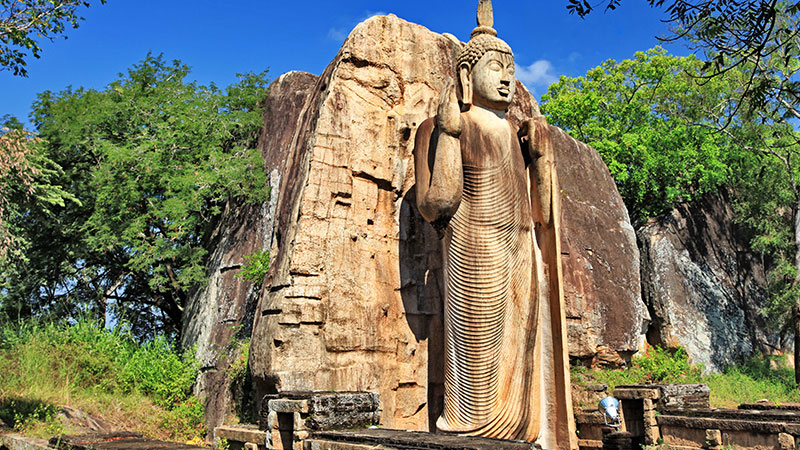
Most people zip straight to Sigiriya Rock without realizing there’s something equally spectacular hiding just down the road. The Aukana Buddha Statue Sri Lanka keeps tucked away in a sleepy village represents one of those discoveries that makes you question why guidebooks don’t scream about it from every page.
This thing is massive – we’re talking about a 40-foot granite Buddha carved from one solid piece of rock more than a thousand years ago. Yet somehow it manages to stay off most tourist radars, which honestly works out perfectly for anyone who prefers their ancient wonders without selfie sticks and tour bus crowds.
The whole place has this almost forgotten quality, like stumbling across a lost temple in an adventure movie. Except this isn’t Hollywood – it’s real history standing right there in front of you, weathered but still magnificent after all these centuries.
Two Sculptors, One Epic Rivalry
So there’s this old story locals love telling about how the statue came to exist. Apparently there were these two guys—a master sculptor and his student—who got into what was basically an ancient art competition. Winner takes all, loser goes home empty-handed.
The challenge seemed simple enough: carve a Buddha statue, ring a bell when you’re done, collect your reward from the king. The master finished his work (that’s our Aukana Buddha) while his student never managed to complete his project over at Sasseruwa. You can still see that
unfinished statue today, sitting there like someone just walked away mid-chisel.
Course, historians have been arguing about when this actually happened for decades. Everyone assumed it was 5th century stuff until some archaeologist found an inscription in 1951 that basically said “nope, try the 8th century instead.”
That timeline shift actually makes more sense when you think about it. The 8th century was when different Buddhist schools were competing for influence in Sri Lanka. Building something this impressive would’ve been like planting a very large, very permanent flag.
Why "Sun-Eating" Fits Perfectly
Aukana means “sun-eating” in the local language, which sounds like poetry until you see what happens at sunrise. Then it becomes obvious why ancient people came up with such a vivid description.
The statue faces east, looking out over Kala Wewa reservoir. When dawn breaks, sunlight hits that carved stone face in a way that makes the whole thing seem almost alive. It’s one of those natural light shows that photographers dream about but rarely capture properly. What really gets you is the precision involved. Raindrops falling off the Buddha’s nose land exactly where ancient sculptors carved a tiny catch basin between the toes. That level of mathematical accuracy wasn’t accidental—these craftsmen knew exactly what they were doing.
Details That Keep Revealing Themselves
The hand position here is pretty special—it’s called Asisa Mudra, and you won’t see it much outside Sri Lanka. Most Buddha statues show different gestures, but this blessing pose with one hand raised seems to be a local favorite for standing figures.
Look closer at the robe carving and you’ll start noticing how the fabric seems to flow despite being solid granite. The sculptor managed to suggest the body underneath without making anything obvious or crude. It’s sophisticated work that shows influence from Indian art schools but maintains its own character.
The flame symbol on top of the head represents enlightenment, though the current version got added in 1870 after the original was damaged. Archaeologists found pieces of the earlier version, so they know something was always meant to be there.
Everything follows traditional proportions where the body height equals nine face-lengths. Ancient sculptors used these mathematical ratios to ensure proper proportions, combining religious symbolism with practical geometry.
Clever Engineering Nobody Notices
Here’s something that’ll surprise you: the statue looks completely free-standing but actually connects to the rock face through a narrow support strip hidden at the back. Brilliant engineering that creates visual impact while ensuring the thing doesn’t topple over during earthquakes or
storms.
The lotus base was carved separately and positioned underneath, which added serious complexity to an already ambitious project. Each petal looks ready to bloom, creating this sense of the Buddha floating on an eternal flower.
Originally, a huge temple building surrounded the statue. Foundation remains show it measured roughly 74 by 63 feet—pretty impressive real estate for any era. The combination of stone foundation and brick walls would’ve created dramatic interior space, though now you have to use
imagination to picture the original grandeur.
Perfect Side Trip from Sigiriya
Location-wise, Aukana couldn’t be better positioned for anyone exploring the Cultural Triangle. It’s about 30 kilometers northwest of Dambulla, making it an easy addition to Sigiriya itineraries. Many travelers staying at places like Sigiriya Jungles Hotel end up calling this their favorite Cultural Triangle discovery.
Getting there involves taking the Dambulla-Anuradhapura road, then turning onto Talawa road at Kekirawa before making a left at Ehalagama junction. The whole drive takes maybe 45 minutes from Sigiriya, assuming normal traffic.
Dawn visits need advance coordination, but the Sigiriya Jungles hotel in Sigiriya can arrange early morning transportation with guides who know the best viewing spots and timing. These accommodations usually have relationships with site management that make special access possible.
Additional Attractions Worth Exploring
The incomplete statue at Sasseruwa makes an interesting comparison point, showing ancient carving techniques at various completion stages. Seeing both gives you better appreciation for the skill involved in finishing something this ambitious.
Kala Wewa reservoir nearby provides scenic picnic opportunities with historical significance. The engineering behind this ancient irrigation system remained unmatched for centuries, representing sophisticated hydraulic knowledge.
Other archaeological sites scatter throughout the region. Ritigala monastery ruins hide in jungle- covered hills while smaller temples dot rural landscapes. Each location adds context for understanding this golden period of Sri Lankan Buddhist art.
Visitor Information and Etiquette
Dress codes apply—long pants or sarongs are required, shoulders must stay covered. Entry costs 1,500 rupees, which seems reasonable given the historical importance. Photography is allowed with appropriate respect for the religious setting.
Best visiting months run January through April during dry season when weather conditions cooperate. Early morning timing provides optimal lighting while avoiding midday heat. Remove shoes before entering sacred areas, following standard Buddhist temple protocols.
Bring flashlights for dawn visits since pathways can be tricky in low light conditions. The sunrise experience justifies minor inconveniences. Hotels like Sigiriya Jungles can arrange logistics while connecting you with knowledgeable local guides who share historical details and
stories that typical guidebooks miss.
Religious Significance That Continues
Many Sri Lankans consider the statue spiritually powerful, believing it brings healing and good fortune to sincere visitors. Even skeptics often find something moving about standing before this ancient creation that has overseen a thousand years of human drama.
Recent destruction of similar Buddhist monuments elsewhere has increased Aukana’s importance as cultural heritage. This statue represents artistic achievement and continuity in a world where ancient treasures face increasing threats.
Local pilgrims still visit regularly, leaving flower offerings and burning incense in traditional devotion. Watching contemporary worship of this millennium-old masterpiece creates connections between past and present that few experiences can match.
Beyond Typical Tourism
The Aukana Buddha offers something increasingly rare—genuine encounter with artistic greatness that can’t be reduced to social media content. Standing before this granite giant while morning light reveals details carved by ancient hands creates appreciation for human creativity that transcends simple sightseeing.
Whether you’re motivated by historical curiosity, artistic interest, or spiritual exploration, Aukana delivers depth that surface-level tourism rarely provides. It’s the kind of place that reminds you why travel can be transformative rather than just recreational.
This hidden masterpiece near Sigiriya Rock provides authentic wonder in an age of manufactured experiences. True greatness doesn’t need promotion or packaging—it simply endures, continuing to inspire anyone fortunate enough to discover its quiet magnificence across the centuries.