15th June 2026
Hela Wedakama: The Sri Lankan Ayurvedic Medicine
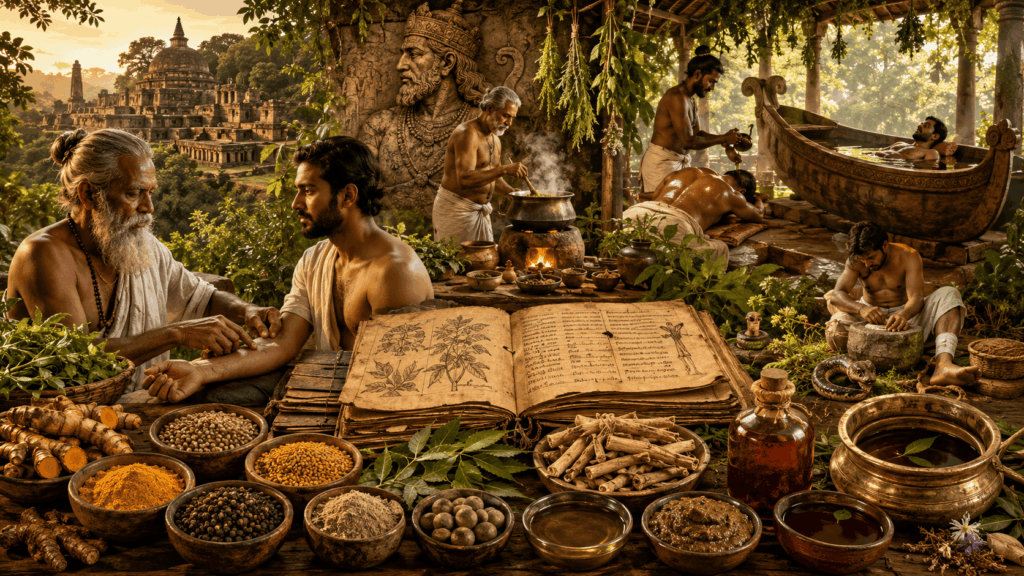
Your trip to Sri Lanka could focus on beaches, wildlife, UNESCO World Heritage sites, bird photography, serene resorts, or majorly the culture alone. No matter which corner of the island you are at, every now and then, you will experience a whiff of herbal elements from Ayurvedic spas, big and small. This is where you get to rejuvenate yourself and potentially, based on the time you allocate for it, reconnect with your inner self. Undoubtedly, there is so much the western world must have heard about Ayurveda — but not about Hela Wedakama.
While Ayurveda traces its origins to India, Hela Wedakama is Sri Lanka’s own indigenous healing tradition. There are multiple curious reasons for this small island to become the World’s Top Wellness Destination of 2026. And it begins way before recorded, verified history.
According to the Hindu mythology, Ramayana, when Lord Hanuman carried the Himalayan mountain containing the life-restoring Sanjeevani herb to save Lakshmana, fragments of the mountain are believed to have fallen at several locations across Sri Lanka, including Dolukanda, Ritigala, Rumassala, Thalladi, and Kachchativu. These places are traditionally associated with an exceptional diversity of medicinal plants and have long been regarded as important centres of herbal knowledge. While this connection belongs to mythology rather than verified history, the legend has become an integral part of Sri Lanka’s cultural identity, symbolically linking the island’s remarkable botanical wealth with the ancient healing traditions that continue to inspire the practice of Hela Wedakama today.
What is Ayurveda?
In Ayurveda, food is the primary medicine. If you were to visit a local market in Colombo, say the Mount Lavinia Sunday market that bustles from 6 AM to 10 PM, you will notice the depth of Ayurveda’s presence in Sri Lankan foodstyle. Particularly, when you find yourself in a land with ancient Ayurvedic roots, you are bound to get perplexed by the unusual familiarity the islanders’ daily life has with this nature-based medical system. This market is a place where the fruity scent of colourful and texturous indigenous fruits like Lovi, Lavulu, Beli, Jambola, Mangosteen, Rambutan, Ambarella, Jambu, Passionfruit, Breadfruit, and many more will turn your head, while the local vendors educate you on the benefits of having them with their make-do English language skills. Most often, they even let you taste them before buying.
Besides the fruits and vegetables, you will also end up staring curiously at the betel nut fruits, cocoa fruit, dried tobacco leaves, green to dry versions of the spices, diverse dried fish, palm tubers, Kithul jaggery, buffalo curd, and maybe even a cat that patiently waits for the fish seller to discard a few pieces. As you shuffle your way in, you will come across rows of sellers with bundles of greens serving multiple health benefits, fern-like stems, shoots, and roots, most of which you will have no idea of. And that’s just the tip of the Ayurveda iceberg in Sri Lanka.
Most visitors to Sri Lanka encounter classical Ayurveda — the system imported from the Indian subcontinent, rooted in Sanskrit texts like the Charaka Samhita, and dating back to the first millennium BCE. It is structured, philosophically layered, and built around three fundamental energies called doshas that govern everything from your digestion to your personality.
According to Ayurveda medicine, every person is born with a unique combination of all three — but one or two tend to dominate, and that balance shapes your entire constitution.
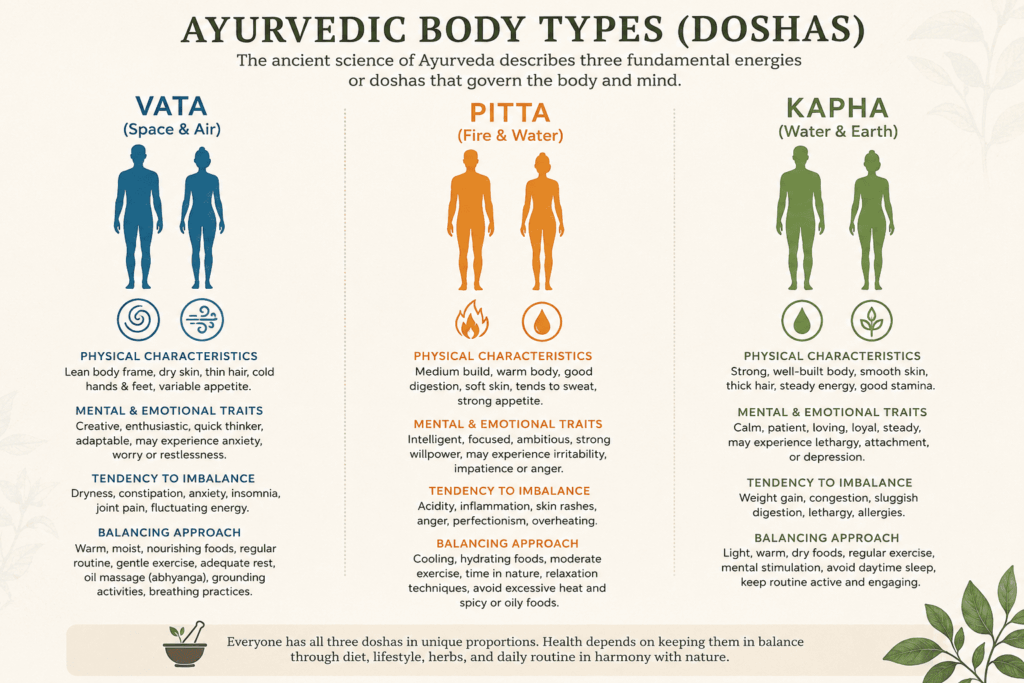
Vata (air + ether) — The energy of movement
Vata governs breathing, circulation, nerve impulses, and the movement of food through the digestive tract. When balanced, Vata types are creative, quick-thinking, and energetic. When out of balance, triggered by irregular sleep, cold weather, stress, or too much travel, they become anxious, scattered, and prone to insomnia, dry skin, and digestive issues like bloating and constipation.
Pitta (fire + water) — The energy of transformation
Pitta governs digestion, metabolism, body temperature, and the processing of information and emotions. Balanced Pitta types are sharp, focused, ambitious, and warm. Imbalanced, they run hot — literally and figuratively. Inflammation, acid reflux, skin rashes, and a short temper are classic signs that Pitta needs cooling down.
Kapha (earth + water) — The energy of structure and stability
Kapha governs physical form, immunity, and fluid balance. Kapha types tend to be calm, loyal, and physically strong. Imbalanced Kapha leads to sluggishness, weight gain, congestion, and emotional heaviness — what we might loosely call a tendency to hold on to things, physically and emotionally, longer than is useful.
The goal of Ayurvedic treatment is never to eliminate a dosha — they are all necessary — but to restore balance when one has gone into excess. Diet, herbal medicine, oil therapies, daily routines, and seasonal adjustments are all calibrated to this purpose.
Guess what? Ayurveda suggests your dominant dosha can even influence your food preferences and how you handle heat. A classic Pitta imbalance? Craving cold drinks and ice cream in the middle of a Sri Lankan afternoon. The Ayurvedic prescription, counterintuitively, is to avoid them, as cold suppresses the digestive fire (Agni) and makes the underlying imbalance worse.
While Hela Wedakama shares this doshic framework as a foundation, what it built on top of it is entirely its own.
Hela Wedakama: The Sri Lankan Ayurveda
Hela Wedakama, also known as Deshiya Chikitsa or Hela-Veda, is the indigenous Sinhala healing tradition of Sri Lanka. The name itself carries history. Sri Lanka was historically called Hela-Diva — Hela being the tribes that inhabited the island over 5,000 years ago, and Diva meaning island. Those early tribes had developed an extraordinary body of knowledge in agriculture, irrigation, and herbal medicine, distinct from and believed by some scholars to predate Indian Ayurveda medicine entirely. The founder of this system is attributed to Rishi King Pulasthi — grandfather of the legendary King Ravana — who is said to have written three foundational medical texts, one of which described a distillation process called arka that is still practiced today.
An Island With the World’s Oldest Hospital
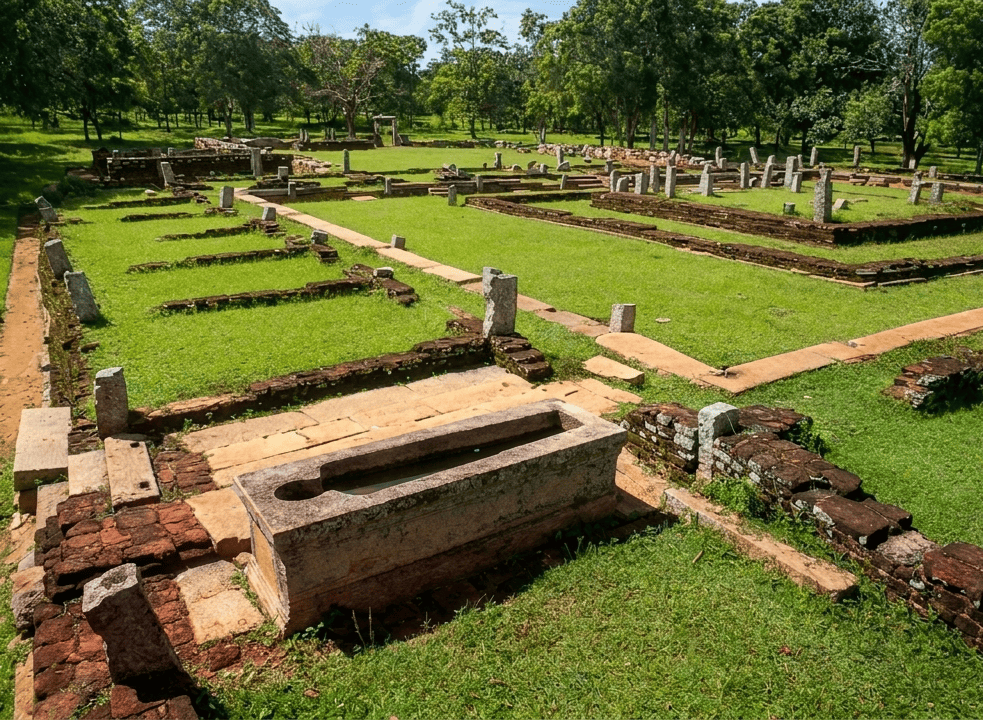
Before there was organized healthcare anywhere in the modern sense, Sri Lanka had it. The ancient chronicle Mahavamsa records that King Pandukabhaya (437–367 BC) built hospitals — Sivikasotthi-Sala — across the island, making this the earliest documentary evidence of institutions specifically dedicated to the care of the sick anywhere in the world. After King Devanampiyathissa (307–267 BC) converted to Buddhism, he established a hospital for Buddhist monks at Mihintale. Among the ruins still standing today are the remains of a body-shaped stone trough — the beheth-oruwa, or medicinal boat — in which patients were immersed in herbal oils. Mihintale hospital complex is widely considered the first proper hospital in the world.
Of the many physician-monarchs who shaped Hela Wedakama, King Buddhadasa (340–368 AD) is the most celebrated. He was simultaneously a surgeon, a general practitioner, and a veterinarian — and reportedly always carried surgical instruments and medicines in a small bag wherever he went. One account describes him dismounting from his royal elephant to surgically remove a tumour from a writhing snake. His medical text, Sarartha Sangrahaya, is still referenced by traditional physicians today. King Buddhadasa represents something the modern world finds difficult to reconcile: a ruler whose power was inseparable from his commitment to healing.
Hela Wedakama vs. Ayurveda in Sri Lanka
Both systems share a philosophical foundation — health as balance, disease as disruption, and the body, mind, and spirit as one inseparable unit. Both draw on pulse diagnosis (Nadi Pariksha), tongue and eye examination, herbal decoctions, oil therapies, and detox regimens. A tourist receiving treatment at a traditional spa may never notice the difference between the two.
But the distinctions run deep. Classical Ayurveda medicine follows structured, text-based protocols derived from Sanskrit literature. Hela Wedakama had no single canonical scripture. Its knowledge was transmitted orally — father to son, grandmother to granddaughter — or inscribed on ola leaf manuscripts, strips of palmyrah palm that aged well enough to survive centuries of use. These manuscripts, known as puskola, preserved symptom profiles and herbal remedies that generations of village physicians relied upon without ever attending a formal school.
The materia medica of Hela Wedakama is also its own. While Ayurveda in Sri Lanka draws on classical plants like turmeric, neem, and ashwagandha, Hela medicine centers on the island’s endemic jungle herbs — nelli (Phyllanthus emblica), aralu (Terminalia chebula), rasakinda (Tinospora cordifolia), nika (Vitex negundo), bul (Costus speciosus), and katupila (Trichosanthes dioica). The island holds over 1,100 plant species used in herbal medicine, including many endemics found nowhere else, which is precisely what makes Hela-Veda both irreplaceable and impossible to fully replicate elsewhere.
Specialized Knowledge, Held by Families
One of the most striking characteristics of Hela Wedakama is how its knowledge was compartmentalized by family lineage. Certain clans — called velas — specialized in one condition for generations, guarding their formulas as ancestral inheritance. One family handled snakebite (sarpavisha). Another dealt exclusively with burns (vidum pillissum). Another, fractures (kadum bidum). Eye disease (es vedakama) and rabies-like conditions (pissubala) each had their dedicated lineages. These were not generalists. They were specialists in the oldest sense, and their methods — including the pissuwa ritual involving herbal foot treatment for hydrophobia symptoms — reflected a highly localized, highly evolved response to the specific dangers of life on this particular island.
This family-to-family transmission meant that Hela Wedakama never required a university. The alaya vedamas, or hereditary physicians, held no formal certification. But in rural Sri Lanka, they held — and in many places, still hold — a cultural authority that no degree can manufacture. Today, approximately 8,000 unregistered hereditary healers continue to practice across the island, operating alongside the roughly 20,000 registered practitioners covered by Sri Lanka’s Ayurveda Act of 1961, which legally subsumes Hela Wedakama under the broader category of Deshiya Chikitsa.
Buddhism, the Mind, and the Whole Person
Hela Wedakama’s relationship with Buddhism is not incidental, but structural. One of the oldest classical texts of Hela-Veda, Bisajja Manjusa, written by the Reverend Anomadassi Thero in 2 BC and declared a UNESCO national heritage in February 2016, records that ancient Sri Lankans preserved their psychological balance through the Tripitaka (the three main texts of the Buddhist canon) and their physical health through Hela Wedakama. The two systems divided their responsibilities cleanly: spiritual and mental wellbeing through Buddhism, physical and physiological healing through traditional medicine.
This integration explains something that still puzzles anthropologists and medical historians: how an ancient civilization with no psychiatrists or psychologists built the Sigiriya rock fortress, vast irrigation networks, giant Buddha statues, and stone temples that have stood for over two millennia. The answer, at least in part, lies in the social and spiritual architecture of daily life — one that Hela Wedakama was an active component of, not merely a peripheral practice.
What Foreign Observers Said
The efficacy of Hela-Veda was not lost on outsiders. The English sailor Robert Knox, writing in 1681, observed that the woods functioned as an apothecary’s shop, where local healers used herbs, leaves, and bark to perform cures that impressed him considerably.
The Portuguese soldier-historian Joao Ribeiro, who served in Sri Lanka from 1641 to 1658, wrote in Fatalidade Historia De Ceilao that local healers could cure tumors, broken limbs, and even cancer within days — conditions that were considered largely untreatable in Europe at the time — without leaving a trace of the disease.
He documented witnessing soldiers and officers recover from wounds with a speed he described as marvelous. These were not the observations of wellness enthusiasts. They were records of military men with pragmatic incentives to assess what actually worked.
More recently, Dr. C.G. Uragoda’s 2000 study Traditions of Sri Lanka noted that juice from the leaves of Adhatoda vasica, a plant long prescribed in traditional medicine for lung conditions, has a direct synthetic analogue — Bromhexine — that is now widely used in commercial cough syrups as an expectorant. The herb was there first. The pharmaceutical came later.
Hela Wedakama Preparations and How They Are Made
The pharmacology of Hela Wedakama overlaps significantly with classical Ayurveda medicine in its forms, even when the ingredients diverge. Both systems work with
- kasaya (decoctions of bark, roots, leaves, or fruits boiled down to a quarter of the original volume)
- churna (medicinal powders)
- guli (tablets or pills)
- thaila (medicated oils processed over days)
- lepa (external pastes)
- asava (fermented herbal preparations).
Arishta, an elixir-type rasayana preparation, is fermented over extended periods to preserve its potency. Leha, a semi-solid preparation using jaggery or sugar as a base, is another traditional form still prepared in households.
What distinguishes Hela preparations in practice is the method and the measurer. Where formal Ayurveda uses standardized weights and pharmacopeial procedures, traditional Hela healers measured by sight, taste, and generational instinct. The decoction was right when it looked and smelled right. The oil was ready when it felt right between the fingers. This is not imprecision — it is a different epistemology, one that resists standardization by design.
The Kitchen as Clinic
The deepest layer of Hela Wedakama is not found in a hospital or a spa, but in the Sri Lankan kitchen. Kola kanda, the herbal rice porridge consumed at dawn in traditional households, is built on the same principles as a medicinal decoction. Kohila (Centella asiatica), now a globally sought-after ingredient in skincare and cognitive health supplements, has been a staple of the Sri Lankan diet for centuries. Rasakinda supports immunity. Nika addresses respiratory conditions. The spices in a typical Sri Lankan curry — turmeric, coriander, fenugreek, black pepper — are not there for flavor alone. They represent a daily maintenance dose of the healing system, consumed without ceremony, twice a day, every day.
This is what makes Sri Lankan traditional medicine distinct from wellness tourism’s curated version of it. The spa is the visible layer. The kitchen is the foundation.
A Living System Under Pressure
Sri Lanka’s government formally recognizes Hela Wedakama under the Ayurveda Act of 1961 and runs over 50 Ayurveda hospitals and 200 dispensaries nationwide, most free of charge. The Ayurvedic Drugs Corporation recorded its highest-ever revenue in 2025, driven by expanded cultivation of medicinal plants. And yet, the indigenous knowledge that underlies it all — the family-held formulas, the oral traditions, the specialized lineages — remains largely undocumented and increasingly at risk as younger generations migrate to cities.
UNESCO’s recognition of the Bisajja Manjusa manuscript is one step toward preservation. Ethnobotanical surveys of Sri Lanka’s endemic medicinal plants are another. But what the island genuinely holds — over 5,000 years of uninterrupted healing knowledge, shaped by its specific geography, its Buddhism, its ecology, and its people — is something that no database alone will capture. Hela Wedakama was never just a medical system. It was the operating system of an entire civilization’s relationship with health. The question is how much of that can still be read before the last of its living manuscripts are gone.