15th July 2026
Sigiriya UNESCO Status Explained: Latest Updates
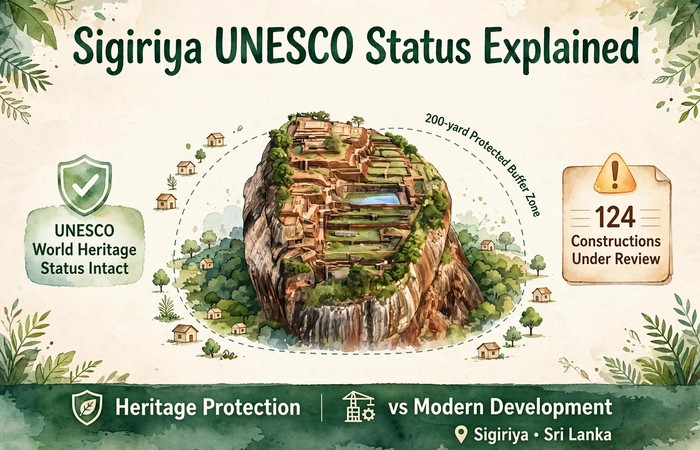
Sigiriya has fascinated travellers for generations with its dramatic rock fortress, ancient gardens, and remarkable engineering achievements. Recognised as a UNESCO World Heritage Site in 1982, the Ancient City of Sigiriya remains one of Sri Lanka’s most valuable cultural landmarks and one of Asia’s most extraordinary archaeological destinations.
However, recent discussions surrounding Sigiriya UNESCO status have attracted global attention after reports emerged that 124 unauthorized constructions were identified within protected areas surrounding the heritage site.
For travellers planning a visit, the most important point is clear: Sigiriya has not lost its UNESCO World Heritage status. There has been no announcement that the site has been removed from the World Heritage List. Instead, the current discussions relate to heritage protection, development controls, and the importance of maintaining the cultural landscape surrounding Sigiriya.
Understanding the situation behind the headlines helps visitors appreciate why protecting Sigiriya requires more than preserving the famous Lion Rock itself. The future of this ancient city depends on careful management, responsible tourism, and ensuring that modern development respects the historical significance of the area.
While Sigiriya continues to welcome visitors from around the world, recent reports about Sigiriya unauthorized constructions have shifted attention towards how this globally recognised heritage site is protected. The discussion has involved travellers, tourism professionals, conservationists, and local authorities who all share an interest in preserving Sigiriya’s cultural importance.
Some reports and online discussions have raised concerns about whether these developments could affect Sigiriya UNESCO status, creating confusion among travellers who want to understand what is actually happening.
Before drawing conclusions, it is important to separate verified information from speculation and understand how UNESCO World Heritage protection works.
The reality is that Sigiriya UNESCO status remains unchanged. The Ancient City of Sigiriya continues to be recognised as a UNESCO World Heritage Site. The current discussions focus on protecting the heritage landscape through appropriate planning measures, including the management of development around the site.
Whether you are planning your first visit or returning to explore Sri Lanka’s Cultural Triangle once again, understanding the story behind Sigiriya UNESCO status is quite useful for travellers. It helps them appreciate why preserving this destination involves far more than protecting a single rock—it requires safeguarding an entire cultural landscape.
What is Happening at Sigiriya?
The current discussion began after Sri Lankan authorities reported that 124 buildings and structures had been identified within protected areas surrounding Sigiriya. According to local news reports, these constructions fall within 200-yard and 400-yard buffer zones, areas where development is regulated because of their archaeological and cultural importance.
The matter gained national attention during a high-level meeting chaired by Sri Lanka’s Minister of Tourism, where government officials discussed measures to safeguard the integrity of the UNESCO World Heritage Site while balancing tourism development and community needs.
It is worth noting that the announcement does not mean every identified structure will automatically be demolished. Instead, authorities are reviewing planning approvals, land-use regulations, and conservation requirements to determine which developments comply with existing laws.
This distinction is important.
The issue is fundamentally about planning and heritage management, not about tourism itself. In fact, well-managed tourism is widely recognised as one of the strongest tools for protecting World Heritage Sites by generating income for conservation, creating employment for local communities, and encouraging governments to preserve nationally significant landmarks.
For travellers, this means there is no reason to cancel a trip to Sigiriya. Instead, it is an opportunity to understand how responsible tourism can contribute to protecting one of Asia’s most remarkable archaeological landscapes.
Why Sigiriya Is More Than Just Lion Rock
Many visitors arrive expecting to climb a spectacular rock fortress, and while that experience is unforgettable, Sigiriya’s UNESCO designation extends far beyond the summit.
The property inscribed on the World Heritage List includes an extraordinary cultural landscape comprising:
- the famous Lion Rock fortress
- sophisticated royal water gardens
- boulder gardens and terraced gardens
- ancient reservoirs and hydraulic systems
- palace foundations
- frescoes and the Mirror Wall
- forested surroundings
- archaeological remains that continue to be studied today
These elements work together to tell the story of King Kashyapa’s ambitious royal capital in the 5th century CE. Archaeologists continue to uncover new information about the site’s design, engineering, and historical significance, making the surrounding landscape just as valuable as the rock itself.
This is precisely why Sigiriya buffer zone rules exist. Protecting the monument alone is not enough; preserving the setting that gives it meaning is equally important.
What Are Sigiriya Buffer Zone Rules?
At first glance, the phrase “Sigiriya buffer zone rules” might sound like a set of restrictions designed to limit development. In reality, these regulations are intended to achieve something much bigger: preserving one of humanity’s most significant cultural landscapes.
When UNESCO designates a site as a World Heritage Site, protection extends beyond the monument itself. The surrounding environment—known as the buffer zone—is often just as important because it safeguards the site’s historical setting, archaeological potential, and visual integrity.
Think of Sigiriya not as a single rock rising from the jungle, but as an entire ancient city. The fortress, gardens, reservoirs, forests, pathways, and surrounding plains were all part of one carefully planned royal complex during the reign of King Kashyapa I (477–495 CE).
If uncontrolled modern construction gradually surrounds the monument, visitors no longer experience Sigiriya as its creators intended. The landscape loses authenticity, and archaeological evidence hidden beneath the ground may be permanently destroyed before researchers even know it exists.
That is exactly what the buffer zone rules aim to prevent.
Why Does UNESCO Require Buffer Zones?
UNESCO introduced the concept of buffer zones to provide an additional layer of protection around World Heritage Sites. Rather than focusing only on the monument itself, buffer zones help preserve the wider landscape that contributes to a site’s Outstanding Universal Value (OUV)—the benchmark UNESCO uses to determine whether a place is of exceptional importance to all humanity.
According to UNESCO’s Operational Guidelines for the Implementation of the World Heritage Convention, a buffer zone should support the protection, conservation, and management of the World Heritage property while helping maintain its visual, environmental, and cultural character.
In practical terms, buffer zones help prevent:
- inappropriate commercial development
- high-rise buildings that disrupt historic views
- unplanned urban expansion
- damage to undiscovered archaeological remains
- excessive infrastructure near sensitive heritage areas
- environmental degradation
Many of the world’s most famous heritage sites—including Machu Picchu (Peru), Angkor Archaeological Park (Cambodia), and Petra (Jordan)—are protected by similar planning controls. Sigiriya is therefore not unique in having development restrictions; it follows an internationally recognised conservation approach used across UNESCO properties worldwide.
Understanding the 200-Yard and 400-Yard Protected Zones
Much of the recent news has referred to 200-yard and 400-yard protected areas around Sigiriya.
These distances represent planning and archaeological control zones where construction is subject to stricter oversight than in surrounding areas. While the exact requirements may vary depending on the location and type of development, the principle remains the same: any activity capable of affecting the heritage landscape requires careful review.
Within these protected areas, authorities may assess factors such as:
- building location
- height and scale
- visual impact on the heritage site
- archaeological sensitivity
- environmental consequences
- compliance with planning regulations
- compatibility with conservation objectives
The purpose is not to prevent all development but to ensure that new projects do not undermine the long-term preservation of Sigiriya.
This balanced approach allows nearby communities and tourism businesses to continue growing while protecting the qualities that make Sigiriya internationally significant.
Who Enforces Sigiriya’s Protection?
Protecting a UNESCO World Heritage Site is a shared responsibility involving several Sri Lankan institutions.
Among the key organisations involved are:
Department of Archaeology
The Department of Archaeology is responsible for safeguarding archaeological heritage throughout Sri Lanka. It oversees conservation work, archaeological research, and the legal protection of ancient monuments.
For sites such as Sigiriya, the department plays a central role in reviewing developments that could affect archaeological resources.
Central Cultural Fund (CCF)
The Central Cultural Fund (CCF) manages several major cultural heritage sites within Sri Lanka’s Cultural Triangle, including Sigiriya.
Revenue generated through entrance tickets helps fund:
- conservation projects
- archaeological excavations
- site maintenance
- visitor facilities
- educational programmes
- heritage interpretation
This funding model demonstrates why responsible tourism is closely linked to heritage protection. Every visitor contributes, directly or indirectly, to the conservation of these nationally important sites.
Urban Development Authority (UDA)
Planning authorities such as the Urban Development Authority may also become involved when reviewing land use, zoning regulations, and construction proposals within protected areas.
Together, these agencies help balance conservation, tourism, infrastructure, and community development.
Why Unauthorized Construction Is a Serious Issue
Some readers may wonder why the construction of a few buildings attracts so much attention.
The answer lies beneath the surface.
The landscape surrounding Sigiriya still contains archaeological deposits that have not yet been excavated. Every new foundation, drainage trench, or road project has the potential to disturb historical evidence that could reveal new insights into Sri Lanka’s ancient civilisation.
Once archaeological layers are destroyed, they cannot be recreated.
There is also the visual aspect.
Imagine standing at the summit of Sigiriya expecting panoramic views of forests, reservoirs, and ancient gardens, only to see dense modern development dominating the landscape. The monument itself might remain intact, but the sense of place—the very experience UNESCO seeks to preserve—would gradually disappear.
Heritage conservation therefore protects both what lies underground and what visitors see above it.
Conservation and Community Can Coexist
One common misconception is that heritage protection works against local communities.
In reality, sustainable conservation aims to benefit both.
When development is properly planned, communities can enjoy:
- improved infrastructure
- stable tourism income
- increased employment opportunities
- higher property values
- stronger destination branding
- long-term economic resilience
Poorly planned development, by contrast, often produces short-term gains but risks damaging the very attraction that supports local livelihoods.
This is why many experts now advocate quality tourism over quantity—encouraging visitors to stay longer, spend more locally, and travel responsibly rather than simply increasing visitor numbers.
For destinations like Sigiriya, this approach helps preserve cultural heritage while creating a more rewarding experience for everyone involved.
Could Sigiriya Actually Lose Its UNESCO World Heritage Status?
One of the biggest questions raised by recent discussions about unauthorized constructions is whether Sigiriya could lose its UNESCO World Heritage status.
The answer requires some context.
UNESCO does not remove World Heritage status simply because a country faces a conservation challenge. In fact, many internationally recognised heritage sites experience ongoing pressures, including tourism growth, climate change, urban development, and environmental threats.
The World Heritage Convention is designed around protection and improvement, not immediate punishment.
When concerns arise, UNESCO follows a structured monitoring process. The country responsible for the site is usually asked to provide information, explain the situation, and demonstrate what actions are being taken to address potential risks.
For a site such as Sigiriya, UNESCO may examine factors including:
- whether national laws protect the heritage property
- whether management plans are being implemented
- whether development affects the site’s Outstanding Universal Value
- whether authorities are taking corrective action
- whether conservation measures are effective
Only in extreme circumstances—where serious threats remain unresolved over time—can a property be placed on the List of World Heritage in Danger or eventually removed from the World Heritage List.
Such cases are extremely rare.
Therefore, the recent concerns surrounding Sigiriya unauthorized constructions should not be interpreted as an immediate threat of losing UNESCO recognition. Instead, they highlight why continued monitoring, planning, and cooperation between authorities, businesses, and communities are essential.
How UNESCO Protects World Heritage Sites Around the World
Sigiriya is not the only heritage site dealing with the challenges of modern development.
Across the world, famous destinations constantly balance conservation with tourism.
For example:
- Machu Picchu in Peru has introduced visitor management measures to control pressure from increasing visitor numbers.
- Venice in Italy has taken steps to manage tourism impacts on its historic centre.
- Angkor Archaeological Park in Cambodia continues to monitor development and groundwater issues affecting ancient structures.
The lesson from these destinations is clear: becoming a World Heritage Site is not the end of conservation work. It is the beginning of a long-term responsibility.
The same applies to Sigiriya.
Maintaining the site’s importance requires ongoing cooperation between:
- government authorities
- conservation experts
- tourism operators
- local communities
- visitors themselves
What Is the Sri Lankan Government Doing About Sigiriya?
The recent attention surrounding Sigiriya has encouraged authorities to review development practices around the heritage site.
Government discussions have focused on improving coordination between tourism, archaeology, and planning authorities.
Possible measures being considered include:
- reviewing existing structures within protected zones
- strengthening approval procedures for future developments
- improving monitoring systems
- increasing cooperation between government agencies
- ensuring tourism growth aligns with conservation goals
The challenge is finding the right balance.
Sigiriya is not a museum frozen in time. Thousands of local residents depend on tourism-related income, and visitors need accommodation, restaurants, transport services, and facilities.
The objective is not to stop development completely.
The objective is responsible development.
Good destination management allows communities to benefit economically while ensuring that the cultural landscape remains protected.
How This Affects Hotels and Tourism Businesses Around Sigiriya
The conversation about Sigiriya buffer zone rules also has important implications for tourism businesses operating around the area.
Accommodation providers, restaurants, and other tourism operators play a significant role in shaping the future of the destination.
Businesses that operate responsibly contribute to conservation by:
- following local planning regulations
- managing waste responsibly
- reducing environmental impacts
- supporting local employment
- protecting natural resources
- educating visitors about heritage preservation
This is where sustainable tourism becomes more than a marketing phrase.
A truly sustainable destination considers the entire visitor journey—from arrival and accommodation to cultural experiences and departure.
For travellers choosing where to stay near Sigiriya, the decision is not only about comfort and location. Supporting responsible properties helps encourage better tourism practices throughout the region.
At Sigiriya Jungles Resort & Spa, sustainability is approached through responsible hospitality practices designed to respect the surrounding environment while allowing guests to experience the natural beauty of the Cultural Triangle.
Why Sustainable Tourism Is Important for Sigiriya’s Future
Tourism has always been closely connected with heritage conservation.
Without visitors, many World Heritage Sites would struggle to generate the resources needed for preservation. However, unmanaged tourism can also create problems.
The future of Sigiriya depends on moving from high-volume tourism towards high-value, responsible tourism.
This means encouraging visitors who:
- stay longer
- explore beyond the main attraction
- support local businesses
- respect cultural sites
- appreciate authentic experiences
Instead of simply asking:
“How many visitors can Sigiriya attract?”
destination managers increasingly ask:
“How can Sigiriya welcome visitors while protecting what makes it special?”
This shift is at the heart of sustainable tourism.
What Can Travellers Do to Protect Sigiriya?
Visitors are an important part of heritage conservation.
Small decisions made by thousands of travellers can have a significant impact.
When visiting Sigiriya, you can help by:
Choosing responsible accommodation
Select hotels and resorts that demonstrate commitment to environmental responsibility, community engagement, and sustainable operations.
Respecting protected areas
Follow official pathways, avoid restricted archaeological areas, and never touch or damage ancient structures.
Reducing waste
Carry reusable water bottles, avoid unnecessary plastic, and dispose of waste responsibly.
Supporting local communities
Choose local guides, purchase authentic crafts, and explore nearby attractions.
Exploring beyond Lion Rock
Sigiriya is part of a much larger cultural landscape.
Nearby experiences such as:
- Pidurangala Rock
- Dambulla Cave Temple
- Minneriya National Park
- Habarana village experiences
- ancient reservoirs and temples
help distribute tourism benefits throughout the region.
The Future of Sigiriya Depends on Responsible Choices
The discussion surrounding Sigiriya buffer zone rules is ultimately about one important question:
How can Sri Lanka protect its ancient heritage while allowing communities and tourism to grow?
The answer lies in balance.
Sigiriya does not need to choose between conservation and tourism. With thoughtful planning, sustainable development, and responsible travel practices, both can exist together.
The recent concerns surrounding 124 unauthorized constructions serve as a reminder that even the world’s most famous heritage sites require constant care.
Sigiriya’s UNESCO status remains intact. However, protecting its future requires continued commitment from authorities, tourism businesses, local communities, and visitors.
Every journey to Sigiriya is a chance to experience history—but also a chance to help preserve it.